
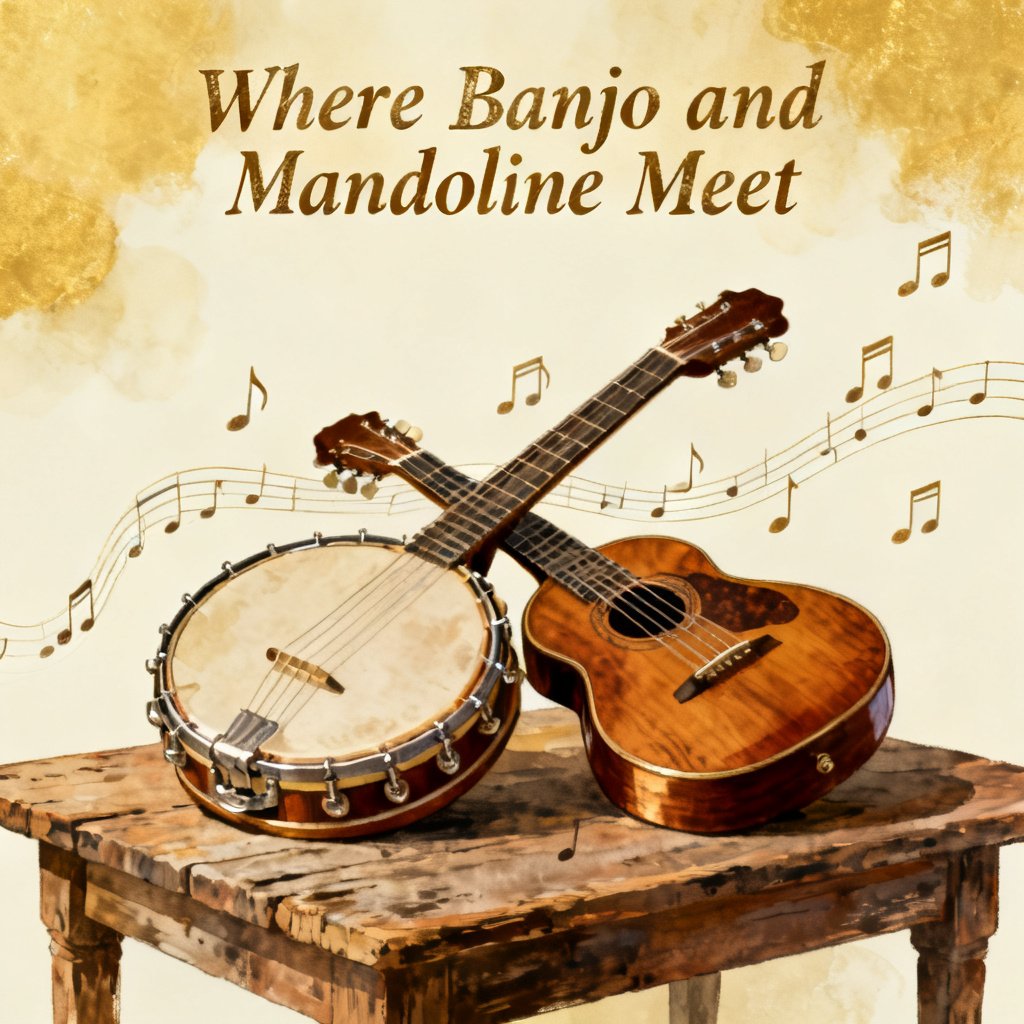
Where Banjo and Mandoline Meet
Where Banjo and Mandoline Meet In music and dance.
A song with lyrics to start with:
Banjo and mandoline rhyme
Fun little musical rhyme inspired by the twangy rhythm of the mandolin and banjo
Mandolin and banjo, they play so sweet,
With strings a-twanging beneath our feet.
We dance and we sway, to their lively beat,
Our bodies moving to the rhythm, oh so neat.
Clogging, square dancing, or freestyling too,
There’s no wrong way to dance, just let loose and do.
With mandolin and banjo, there’s so much to explore,
So put on your dancing shoes and let’s hit the floor!
The music’s fast-paced, so be ready to move,
But don’t worry if you’re a beginner, there’s nothing to prove.
Just let the music guide you, let it take control,
And you’ll find yourself dancing with heart and soul.
Mandolin and banjo, they’re a match made in heaven,
With melodies so sweet and rhythms so revvin’.
So let’s dance and have fun, and enjoy the show,
With mandolin and banjo, we’ll never let go!
Where Music Meets Dance
Two instruments. A wooden floor. A quickening rhythm. And suddenly, nobody wants to sit still.
There is something wonderfully physical about the meeting of a banjo and a mandolin.
The banjo can roll, snap, bounce, pluck, and drive a tune forward. The mandolin can answer with bright chords, rapid tremolo, dancing melodies, and sharp rhythmic accents. Put the two together and the result can feel less like music you simply listen to and more like an invitation:
Get up. Find the beat. Dance.
That playful spirit lies at the heart of our little rhyme:
Mandolin and banjo, they play so sweet,
With strings a-twanging beneath our feet.
We dance and we sway, to their lively beat,
Our bodies moving to the rhythm, oh so neat.
And that raises an interesting question: what happens when string music meets dancing feet?
🪕 The Banjo… Rhythm with a Twang
The banjo has a remarkable ability to make rhythm feel almost visible.
Different playing techniques give the instrument very different personalities.
In clawhammer, commonly associated with old-time music, the player’s hand creates a characteristic down-stroke pattern. Melody and rhythm become intertwined, producing music with a pulse that can work beautifully with traditional dancing.
Then there are two-finger and three-finger picking traditions, in which individual notes can tumble rapidly across the strings.
In bluegrass, the celebrated three-finger style associated with Earl Scruggs uses flowing rolls and syncopation to create a powerful sense of forward motion. A banjo played this way can sound as though the tune itself has started running.
Other approaches—including melodic and single-string techniques—allow banjo players to negotiate intricate fiddle tunes and fast melodic passages.
So there isn’t really one “banjo sound.“
The banjo can be rhythmic, lyrical, percussive, delicate, or dazzlingly fast.
🎶 The Mandolin… Eight Strings That Love to Dance
Now bring in the mandolin.
Its four pairs—or courses—of strings give it a bright, penetrating voice. Because the instrument’s notes decay relatively quickly, players developed techniques that create both rhythmic excitement and sustained musical lines.
One of the most recognizable is tremolo: rapidly repeating a note with alternating pick strokes, creating the impression of a long, singing tone.
But the mandolin can also become a formidable rhythm instrument.
In bluegrass, players often use a sharp offbeat “chop” chord, helping create the rhythmic framework of an ensemble. In old-time and traditional fiddle music, the mandolin can follow melodies, decorate them, or weave around other instruments.
And the mandolin family reaches far beyond American bluegrass. Related mandolin traditions can be heard in Italian music, classical repertoire, Celtic and European folk traditions, and many contemporary musical hybrids.
The little instrument travels remarkably well.
👞 When the Floor Becomes an Instrument… Clogging
Our rhyme continues:
Clogging, square dancing, or freestyling too,
There’s no wrong way to dance, just let loose and do.
Clogging makes an especially exciting partner for string-band music because the dancer doesn’t merely move to the rhythm.
The dancer can become part of the rhythm.
Feet strike, brush, shuffle, and accent the floor, adding percussion to music already propelled by plucked strings. In ensemble settings, fiddle, banjo, mandolin, guitar, and bass may establish the groove while dancers answer it with their feet.
Suddenly we have a conversation:
Banjo: twang-a-twang-a-twang…
Mandolin: chop! chop!
Feet: tap-shuffle-step!
Music becomes movement, and movement becomes music.
🕺 Square Dancing … Music as Community
Square dancing introduces another dimension: people moving together.
Traditionally, dancers follow figures or instructions from a caller while musicians maintain the musical momentum. Instead of concentrating on elaborate individual choreography, participants respond to patterns, partners, timing, and one another.
That makes the dance social as well as musical.
A tune goes around and around. Couples turn. Partners change position. Someone misses a figure and laughs. The musicians keep playing.
The goal isn’t necessarily perfection.
It is participation.
That idea fits our rhyme particularly well:
But don’t worry if you’re a beginner, there’s nothing to prove.
Just let the music guide you, let it take control,
And you’ll find yourself dancing with heart and soul.
💃 Freestyling … Forget the Steps
And what if you don’t know how to clog?
What if you’ve never attended a square dance?
Then forget the names of the steps.
Freestyle.
Tap a foot.
Bounce your shoulders.
Clap on the beat.
Turn around.
Invent a ridiculous dance.
The relationship between folk music and dance doesn’t have to live exclusively inside formal traditions. One of music’s simplest pleasures is discovering that a rhythm has persuaded your body to move before your brain has decided what the movement should be called.
For beginners, that can be the perfect doorway into folk dance.
Listen first.
Find the pulse.
Then move.
🎻 One Pair of Instruments, Many Musical Worlds
“Banjo and mandolin music” isn’t a single genre.
Change the picking technique, tempo, repertoire, ensemble, or cultural setting and the musical landscape changes with it.
A clawhammer banjo playing an old-time fiddle tune creates a different texture from a three-finger bluegrass banjo racing through a breakdown. A mandolin chopping chords behind a bluegrass ensemble has a different role from a mandolin carrying a lyrical melody with tremolo.
That variety is part of the fun.
You might encounter:
Old-time music, where repetitive dance tunes, fiddles, banjos, and strong rhythmic patterns can create an earthy, circular groove.
Bluegrass, where banjo rolls, mandolin chops, instrumental breaks, vocal harmonies, and virtuoso playing can generate tremendous momentum.
Fiddle-tune traditions, where musicians pass melodies among instruments and dancers respond to their rhythmic shapes.
Celtic and other folk crossovers, where mandolin and banjo-family instruments have been adapted to reels, jigs, hornpipes, and other dance forms.
And then there are contemporary musicians who mix these sounds with jazz, rock, blues, country, classical music, and experimental styles.
The instruments may be traditional.
What musicians do with them does not have to be.
🎵 Try It Yourself… From Listening to Dancing
Put on a banjo-and-mandolin tune and try a tiny experiment.
First, don’t dance.
Listen for the pulse.
Now listen specifically to the banjo. Is it rolling continuously? Striking a rhythmic pattern? Picking out the melody?
Next find the mandolin. Is it chopping chords between the beats? Playing the tune? Using tremolo?
Now tap one foot.
Add the other.
Let your hands join in.
Congratulations: the border between audience and performer has already begun to disappear.
That is one of the pleasures of dance-oriented folk music. It doesn’t always ask us to sit quietly and admire it from a distance.
Sometimes it asks us to join in.
🪕 + 🎶 + 👞 = A Living Rhythm
Our rhyme ends:
Mandolin and banjo, they’re a match made in heaven,
With melodies so sweet and rhythms so revvin’.
So let’s dance and have fun, and enjoy the show,
With mandolin and banjo, we’ll never let go!
Perhaps that’s the best way to understand the meeting of banjo, mandolin, and dance.
The banjo supplies a pulse.
The mandolin throws sparks into it.
The dancers hear both—and answer with their feet.
For a few minutes, the distinction between musician, dancer, rhythm, and melody becomes wonderfully blurry.
And somewhere between a ringing mandolin string, a rolling banjo phrase, and a shoe striking a wooden floor, folk music becomes what it has so often been:
not simply something to hear, but something to do together.
So put on your dancing shoes.
The strings are already starting.
And an instrumental on top of it…
Multilingual Folk Song Explorer GPT

Engaging and comprehensive folk song guide with interactive and multimedia features.