
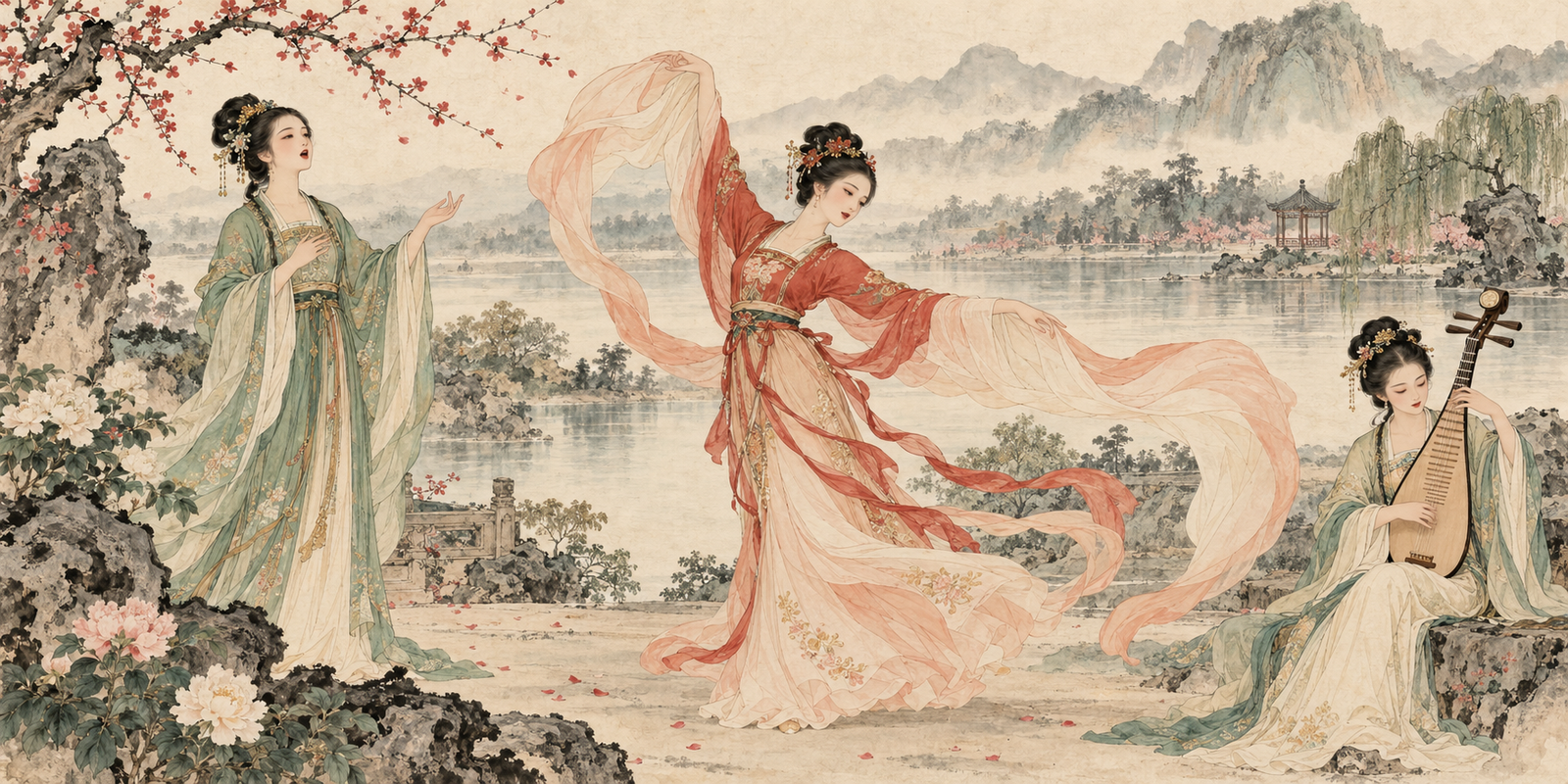
When silk follows the melody
Let us examine the most recognized Chinese folklore songs and dances, with attention to the first lady of China and her artistic contributions. And add our humble contribution with a song: when silk follows the melody.
Before Peng Liyuan became known internationally as China’s First Lady, she was already a celebrated singer. That makes her an interesting doorway into Chinese music—provided we distinguish traditional folk culture from the polished concert and television repertoire she helped popularise. The National
Let us begin with a small musical journey. 🌸
Familiar Chinese songs about flowers, mountains and village life
These are useful starting points rather than a definitive ranking of “the most famous.”
| Song | Roots | What to listen for |
| 茉莉花 · Mò Lì Huā — Jasmine Flower | A traditional song with regional versions; the Jiangsu version is especially familiar internationally. | A graceful, gently unfolding melody: a lovely first encounter with Chinese folk song. |
| 康定情歌 · Kāngdìng Qínggē — Kangding Love Song | Associated with Kangding, Sichuan, in a region of Tibetan and Han cultural contact. | A lilting love song with memorable repeated phrases. |
| 凤阳花鼓 · Fèngyáng Huāgǔ — Fengyang Flower Drum | Anhui’s singing and percussion tradition. | The playful connection between voice, rhythm and movement. |
| 兰花花 · Lán Huāhuā — Lan Huahua | Northern Shaanxi folk tradition. | A more dramatic narrative voice, telling a young woman’s story. |
Carnegie Hall offers a listening and learning introduction to Jasmine Flower. The Fengyang tradition also carries a less cheerful history: performers once travelled and sang to survive poverty and hardship. Folk music can smile while carrying a heavy suitcase. Carnegie Hall
Dances, several traditions, several worlds
“Chinese dance” includes distinct regional and ethnic traditions, each deserving its own name.
| Dance or tradition | Community or region | What to watch |
| Yangge 秧歌 | Northern China, with different regional forms | Festive group movement; compare regional performances rather than assuming one standard dance. |
| Dragon and lion dances | Widespread, with regional styles | The coordination that gives a shared costume its apparent life. These are two separate traditions. |
| Peacock dance 孔雀舞 | Dai communities, Yunnan | Movements suggesting a bird walking, drinking, opening and folding its wings. |
| Guozhuang 锅庄 | Tibetan communities | The communal circle: singing and dancing together. |
| Uyghur Muqam | Uyghur communities, Xinjiang | An extensive tradition joining singing, instrumental music and dance—not a single dance number. |
China’s heritage inventory documents Yangge, dragon and lion dances separately; UNESCO and its associated cultural organisations provide introductions to the other traditions above. Their pages are useful places to watch beyond short tourist clips. en.chinaculture.org
Peng Liyuan and her artistic contribution
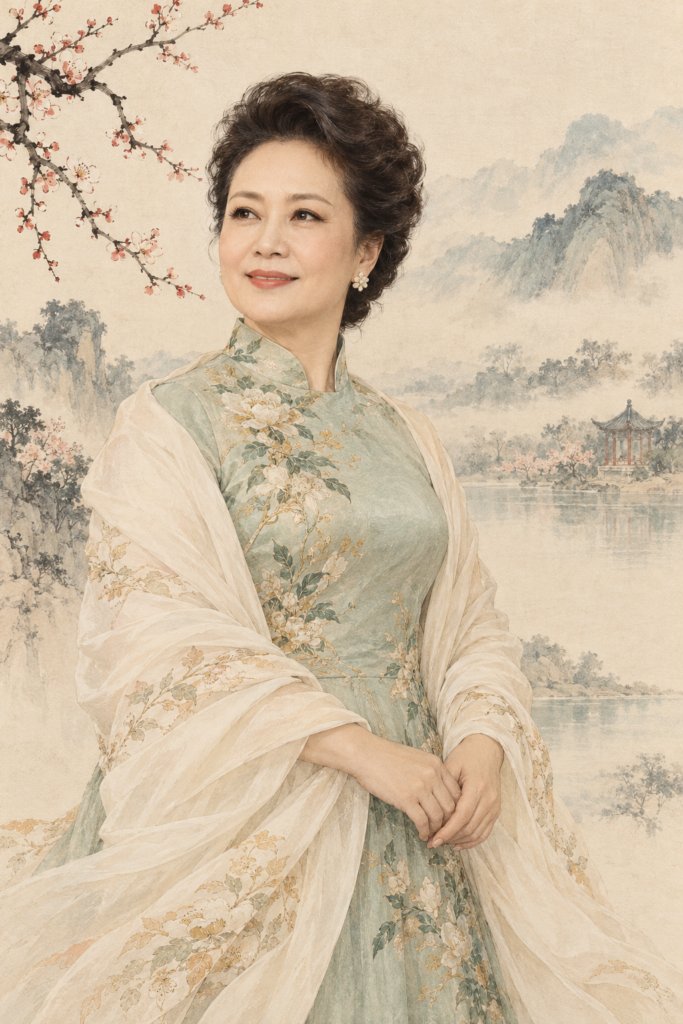
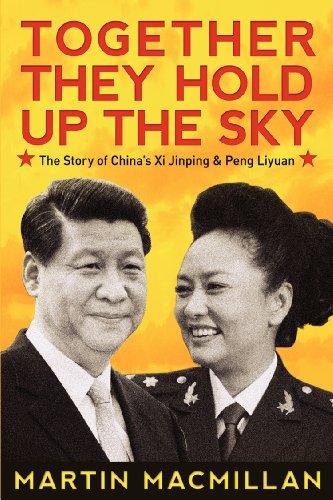
Peng Liyuan 彭丽媛, wife of Xi Jinping, built her reputation as a soprano through military performing ensembles, national television and Chinese opera. Her artistic prominence preceded her husband’s presidency by decades. reuters.com
Her contribution becomes clearer through three listening choices:
- 在希望的田野上 — On the Fields of Hope. One of her signature songs, expressing optimism about rural life. It is a modern composed song in a folk-influenced idiom, rather than an anonymous ancient folk song.
- 谁不说俺家乡好 — Who Wouldn’t Praise My Hometown? A film song drawing on Shandong folk style. Listen for the regional vocal ornaments, including the tongue trills she learned through her teacher Wang Yinxuan.
- 木兰诗篇 — Mulan Psalm / Poems of Mulan. A concert-scale operatic treatment of the Mulan story, in which she originated the title role in the 2004 production. Here, the storyteller becomes a dramatic character. The National
Her central achievement was bringing folk-influenced singing to large modern stages. She is associatedn with minzu changfa: a trained vocal approach combining Chinese vocal traditions with techniques influenced by Western opera. Listen for clear words, sustained high notes and regional ornament within a carefully projected concert voice.
There is also political context: her career developed within state and military arts institutions, and much of her repertoire is patriotic or revolutionary. Appreciating her singing alongside that context gives a fuller picture of her work. Her later cultural diplomacy draws on this established artistic identity. The National
My suggested first session: Jasmine Flower → Kangding Love Song → a Dai peacock dance → Peng’s Who Wouldn’t Praise My Hometown? → On the Fields of Hope.
A flower, a mountain, a bird—and then a voice filling the theatre.


Some online,references
🌸 Let us Start with Peng Liyuan’s two signature songs, then explore the wider folk and dance traditions. These links include recordings, performances and background references.
Peng Liyuan — listen first
| Reference | Link | What to notice |
| On the Fields of Hope 在希望的田野上 | YouTube audio recording | Her clear, ringing soprano and sustained phrases. The recording is credited to Peng Liyuan. |
| Who Wouldn’t Praise My Hometown? 谁不说俺家乡好 | Spotify recording | The ornaments and regional flavour associated with her Shandong repertoire. |
| Peng Liyuan collection | Spotify album | Compare her delivery across several songs, including both titles above. |
The YouTube recording and Spotify catalogue identify these as Peng’s performances. YouTube
For moving performance footage, try these YouTube searches—these are search links, rather than a particular verified upload:
- Peng Liyuan — On the Fields of Hope
- Peng Liyuan — Who Wouldn’t Praise My Hometown?
- Peng Liyuan — Mulan Psalm
Folk songs — watch and compare
- Jasmine Flower — with English translation
A useful introduction for following the song’s meaning. For an educational companion, visit Carnegie Hall’s Mo Li Hua lesson. YouTube - Kangding Love Song — Song Zuying and Plácido Domingo
A 2009 Beijing concert interpretation: useful for hearing how a folk melody becomes a large-stage duet. Song Zuying is a different singer from Peng Liyuan. chinesemusicwiki.com
Dance — watch the hands, feet and group patterns
- Yang Liping — Spirit of the Peacock: YouTube search
A theatrical work drawing on peacock dance traditions. Her choreography and performance brought her national recognition in 1986; watch how her hands and arms suggest the bird. en.chinaculture.org - Dai Peacock Dance — cultural reference
Helpful background for distinguishing community dance traditions from modern stage interpretations. archive.unesco-ichcap.org - Uyghur Muqam — UNESCO, with video
Explore singing, instruments and dance together, within their Uyghur cultural context. ich.unesco.org
For a gentle first sitting: Peng’s On the Fields of Hope, then Jasmine Flower, followed by Spirit of the Peacock. Three different doors into the music and movement.

When Silk Follows the Melody 🌸
An original English song with Chinese instrumental colours ~ a gentle dance beside the misty lake.
Style of Music
Chinese-inspired acoustic folk ballad, graceful lilting 6/8 rhythm, around 76 BPM. Pentatonic melodic phrases with spacious pauses. Delicate guzheng arpeggios, bright pipa plucking, breathy dizi flute answering a warm expressive female soprano, lyrical erhu interludes. Light wooden clappers and soft hand drum. Intimate clear English vocals, restrained ornamentation, flowing phrases. Begin sparsely, blossom gently in the chorus, finish with flute and fading strings. Dreamlike garden atmosphere, silk sleeves moving above still water. Acoustic arrangement, no electronic beat, no cinematic brass.
Lyrics
[Intro — guzheng and breathy dizi]
[Verse 1]
A plum branch leans across the moon,
The lake holds every shade.
One silver string disturbs the hush,
One sleeve begins to sway.
[Verse 2]
Your song goes softly through the leaves,
My footsteps turn to hear.
The mountains fade behind the mist,
Your voice stays bright and near.
[Chorus]
When silk follows the melody,
Let the evening take its time.
One hand opens like a blossom,
One note carries into mine.
Round we turn beside the water,
Till our shadows drift apart.
When silk follows the melody,
I can hear the way you are.
[Instrumental — pipa dance phrase, erhu reply]
[Bridge — voice and guzheng]
Keep one note for when I leave,
Tucked inside your flowing sleeve.
When the garden falls asleep,
Sing the little note we keep.
[Final Chorus — gently fuller]
When silk follows the melody,
Let the evening take its time.
One hand opens like a blossom,
One note carries into mine.
Round we turn beside the water,
Under branches brushed with light.
When silk follows the melody,
Let it linger in the night.
[Outro — softly]
One last turn…
One thread of song…
[Dizi and guzheng fade]
Try the suno audio tool for free.
Compose your own lyrics and music


Multilingual Folk Song Explorer GPT

Engaging and comprehensive folk song guide with interactive and multimedia features.