AI Songwriting
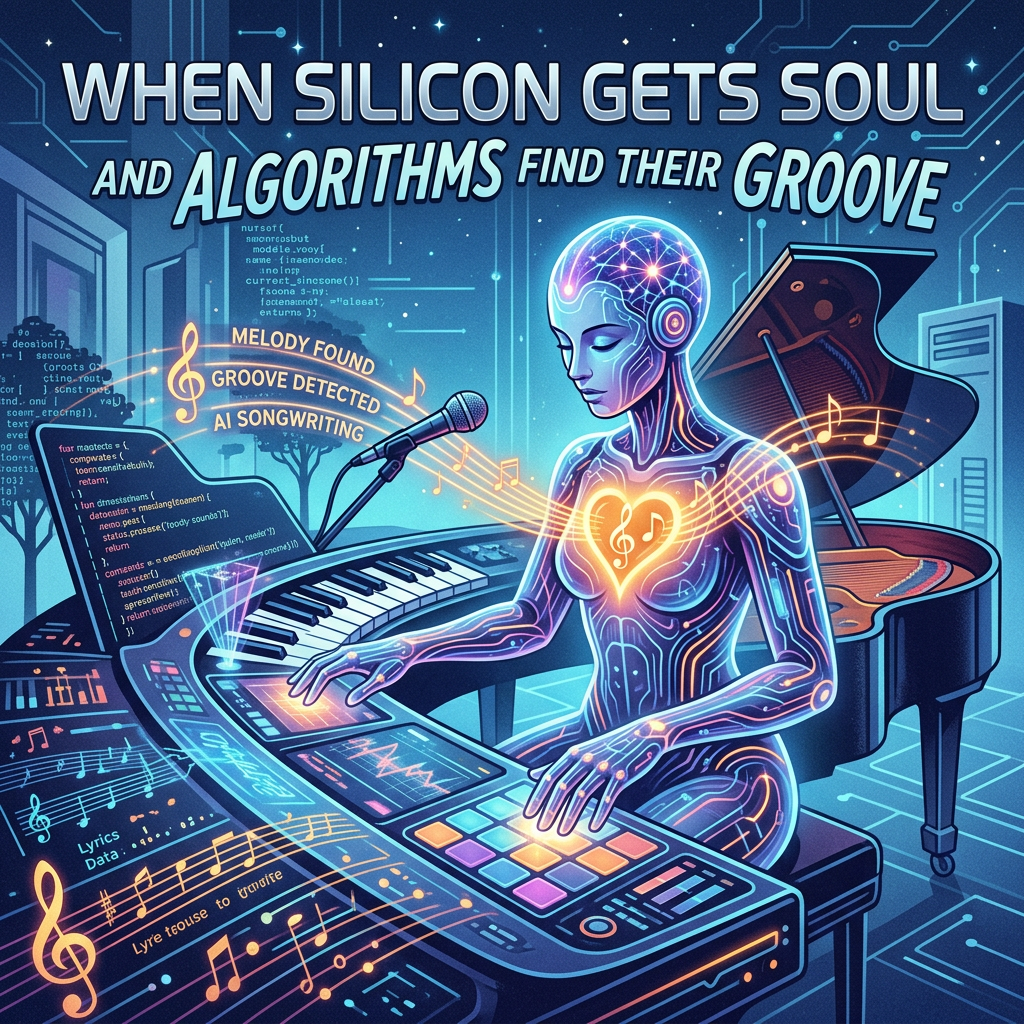
AI Songwriting. When Silicon Gets Soul and Algorithms Find Their Groove
Here’s a fun, witty, and personality-packed article. The key themes? From AI songwriting and creative collaboration to the ethical dilemmas and future possibilities. Using a more playful voice, punchier headings, clever metaphors, and a little musical mischief.
When Silicon Gets Soul and Algorithms Find Their Groove
Move over, Mozart. There’s a new composer in town, and this one doesn’t need coffee, sleep, or a dramatic breakup to write a love song.
Once upon a time, songwriting required three chords, a broken heart, and possibly a questionable haircut. Today? You can invite artificial intelligence into your recording studio, and suddenly your creative partner has processed more music than a radio DJ on an espresso binge.
Welcome to the wonderfully weird world of AI songwriting, where technology tickles the ivories, algorithms flirt with melodies, and creative possibilities are multiplying faster than remixes of a summer hit.
But don’t panic, fellow humans. The robots aren’t necessarily coming for your guitars. They might just help you tune them.
1. From Beeps and Boops to Billboard Dreams
There was a time when computer-generated music sounded like your microwave trying to communicate with your refrigerator.
Charming? Perhaps.
Grammy-worthy? Not quite.
Then artificial intelligence discovered machine learning, and everything changed.
By analyzing enormous collections of musical compositions, AI began recognizing the secret ingredients behind catchy melodies, emotional chord progressions, and rhythms that make even your most rhythmically challenged uncle dance at weddings.
Today, AI can help musicians compose, arrange, experiment with genres, and generate musical ideas in moments.
Think of it as having a musical genius in your pocket—minus the oversized ego and the habit of being late to rehearsals.
The best part? You don’t need a conservatory education or a piano in your living room to get started. With the right tools, almost anyone can experiment with musical creation.
Of course, whether your masterpiece becomes the next global anthem or simply terrifies your cat is another matter.
Try the suno audio tool for free.
Compose your own lyrics and music
2. Behind the Beat. How AI Actually Writes Songs?
So how does a machine go from crunching numbers to creating something you might actually want to dance to?
No, there’s no tiny robot inside your laptop wearing headphones and whispering, “This chorus needs more cowbell.”
The process involves three main ingredients.
First, the musical buffet.
AI systems learn from collections of musical information: melodies, rhythms, harmonies, lyrical structures, and genres ranging from classical masterpieces to catchy pop tunes.
Second, the algorithmic recipe.
Algorithms help systems recognize relationships and patterns in that information. Imagine giving a computer a musical treasure map and watching it learn how different sounds fit together.
Third, the creative cocktail.
Machine learning models use those learned patterns to generate new musical material. Depending on the tool, they may suggest chord progressions, construct melodies, create lyrics, or assemble entire compositions.
You provide the direction; the machine offers possibilities.
Ask for a melancholy piano ballad with cinematic strings, and AI may give you something heartbreakingly beautiful.
Ask for a disco anthem about a lonely potato, and you might discover a surprisingly emotional vegetable.
Technology, darling. What a time to be alive.
Try the suno audio tool for free.
Compose your own lyrics and music
3. Duets With Digital Minds? When Artists and Algorithms Collaborate
The history of music is filled with legendary partnerships.
Lennon and McCartney. Simon and Garfunkel. Beyoncé and a spectacular wind machine.
Now another unlikely duo has joined the stage: humans and artificial intelligence.
Singer-songwriter Taryn Southern explored this creative partnership through her album I AM AI, using AI-assisted composition to help shape her musical vision.
The experimental band YACHT has also explored machine learning as part of its creative process, demonstrating how technology can inspire new directions without erasing an artist’s identity.
The beauty lies in the division of labor.
AI can throw out ideas at extraordinary speed. Humans can decide which ideas deserve to live, breathe, and make someone’s heart skip a beat.
Think of AI as that enthusiastic bandmate who arrives at rehearsal with 47 suggestions before breakfast.
Some will be brilliant.
Some will be bizarre.
And a few should never leave the rehearsal room.
The artist remains the creative director, emotional compass, and final judge of what makes the cut.
After all, just because an algorithm suggests a bagpipe solo in your romantic ballad doesn’t mean you have to keep it.



4. Lyrics, Love Songs, and the Occasional Lyrical Disaster
Let’s talk lyrics.
For centuries, songwriters have stared at blank pages, waiting for inspiration to descend like a poetic angel.
Sometimes the angel arrives.
Sometimes it takes a three-week holiday.
AI doesn’t necessarily solve the mystery of inspiration, but it can certainly give that blank page something to think about.
Using language models, songwriters can experiment with rhymes, metaphors, song structures, themes, and emotional tones.
Need a fresh angle for a breakup song? AI might offer ten.
Want to turn your frustration with Monday mornings into a funky anthem? Consider it a creative challenge accepted.
Tools such as AIVA can assist with musical composition, while language-based AI systems can help brainstorm and develop lyrics.
But there’s one important distinction.
AI can imitate the language of heartbreak. It hasn’t lived through yours.
It can generate a line about missing someone, but it doesn’t know what it’s like to find their forgotten sweater six months later. That particular ache belongs to humanity.
And that is precisely why human editing, experience, and emotional truth remain so valuable.
Use AI to open the door. Then walk through it with your own story.
Try the suno audio tool for free.
Compose your own lyrics and music
5. Meet the Digital Band. AI Tools in the Spotlight?
Once considered futuristic curiosities, AI music tools have become a growing part of the modern creative toolkit.
Different systems tackle different parts of the songwriting journey.
AIVA focuses on AI-assisted composition, particularly for instrumental and cinematic music.
Earlier platforms such as Amper Music, MuseNet, and Jukedeck helped demonstrate how algorithms could generate melodies, arrangements, and complete musical pieces.
Their availability and functionality have changed over time, but their contribution to the evolution of AI music remains significant.
Today’s broader ecosystem offers tools for generating songs, experimenting with arrangements, exploring new sounds, and accelerating production workflows.
For beginners, these technologies can lower some of the barriers to musical experimentation.
For experienced musicians, they can provide creative sparks when familiar techniques begin feeling a little too familiar.
It’s rather like adding an extra instrument to your studio.
Except this instrument might suggest a jazz trumpet, a cinematic orchestra, and a medieval choir in the same breath.
Proceed with curiosity—and perhaps a little caution.
6. The Human Touch? Because Robots Don’t Get Goosebumps
Here’s where the story gets interesting.
AI can analyze thousands of love songs, recognize their structures, and generate convincing lyrics about devotion.
But has it ever waited beside a telephone that refused to ring?
Has it felt the electricity of a first kiss?
Has it stood beneath a spotlight, hearing an audience sing back words written in a lonely bedroom?
No.
And that matters.
Music isn’t simply a mathematical arrangement of pleasing frequencies. It’s memory wrapped in melody. It’s grief with a guitar. It’s joy finding its dancing shoes.
Artists such as Grimes have explored emerging technologies while maintaining their distinctive artistic identities.
The lesson is simple: innovation becomes most interesting when it strengthens personal expression rather than replacing it.
AI may help write the notes.
Humans give those notes a reason to exist.
And when a singer’s voice cracks at exactly the right emotional moment, no one in the audience asks whether the chord progression was computer-assisted.
They’re too busy feeling something.
Try the suno audio tool for free.
Compose your own lyrics and music
7. The Critics Have Entered the Chat
Naturally, not everyone is applauding this digital orchestra.
Some critics worry that AI-generated music could turn creativity into an endless factory of familiar formulas.
Others question ownership, authenticity, and whether artists might eventually struggle to distinguish their work from algorithmically generated imitations.
These concerns deserve more than a dismissive shrug.
If technology learns from existing music, questions arise about training data, permission, compensation, and creative rights.
If an AI system contributes substantially to a song, who deserves credit?
If everyone uses similar tools to chase similar trends, will tomorrow’s music begin sounding suspiciously like yesterday’s?
Imagine a world where every song has the same catchy chorus, predictable emotional climax, and suspiciously perfect beat drop.
A musical buffet where every dish tastes like vanilla.
Efficient? Certainly.
Exciting? Not particularly.
The answer isn’t necessarily to reject AI. It’s to use it thoughtfully.
Artists should understand the terms of their tools, check the rights associated with generated material, respect other musicians’ work, and be transparent where appropriate about AI’s contribution.
Most importantly, they should resist confusing what an algorithm predicts will be popular with what deserves to be created.
Because innovation rarely begins by following everyone else’s footsteps.
Sometimes it begins by playing the wrong note—and realizing it sounds wonderful.
Try the suno audio tool for free.
Compose your own lyrics and music
8. Tomorrow’s Music? Fasten Your Headphones
Now for the exciting question: where does this melodic revolution go next?
Imagine music that adapts to your mood in real time.
A soundtrack that changes as you move from a morning jog to an evening walk.
Or a live performance where AI responds to the musician’s improvisation, making every concert genuinely different.
Future tools could offer increasingly personalized composition assistance, real-time arrangements, and interactive musical experiences.
Music education could also become more accessible through intelligent systems that adapt lessons to individual learning needs.
Struggling with chord theory? Your digital tutor might explain it another way.
Need to practice your timing? It could offer targeted exercises.
Want to combine Afrobeat, jazz, orchestral strings, and electronic dance music?
Your computer may be more adventurous than your bandmates.
Of course, not every futuristic possibility will become a musical masterpiece.
But experimentation has always been part of music’s DNA.
Jazz challenged convention. Rock rattled the establishment. Hip-hop transformed the possibilities of rhythm and language. AI represents another chapter in that restless creative journey.
And the most fascinating sounds may come from artists brave enough to explore territory that doesn’t yet have a genre name.


9. Humans Hold the Mic or how to Find Harmony in a High-Tech World
So, should musicians welcome AI into the studio?
Absolutely—with curiosity, creativity, and a healthy sense of artistic ownership.
Start small.
Use AI to explore chord progressions, brainstorm lyrical concepts, or discover arrangements you might not have considered.
Experiment with its suggestions, but don’t treat every output as a commandment delivered from the cloud.
Keep what resonates. Rewrite what doesn’t. Delete the occasional monstrosity.
Remember that speed isn’t the same as soul, and productivity isn’t the same as purpose.
A hundred generated songs won’t necessarily move someone more deeply than one carefully crafted verse.
Technology can expand your options, but taste, judgment, and personal experience determine what those options become.
The ideal relationship between artists and AI isn’t a battle for creative supremacy.
It’s a collaboration with clear boundaries.
Let the machine handle some of the heavy lifting.
Let the human heart handle the meaning.
After all, a brilliant song isn’t simply something that sounds good.
It’s something that stays with us long after the music stops.


The Final Chorus? Let the Algorithms Play, but Keep Your Soul in the Song
Artificial intelligence is changing how music gets imagined, written, produced, and shared.
It offers extraordinary possibilities, from overcoming creative blocks to discovering sounds we might never have stumbled upon alone.
But music has never been solely about perfection.
It’s about connection.
The beautifully imperfect note. The lyric that knows exactly where you’ve been. The melody that somehow remembers what you’ve forgotten.
AI may be able to generate a thousand songs before lunch.
But one deeply human song can still make a thousand people cry.
And that, dear music lovers, is a kind of magic no spreadsheet can measure.
So plug in, play on, and dare to create. Let technology find the rhythm—but let your heart lead the beat.
Because the future of music doesn’t have to be human versus machine.
It can be human with machine.
And who knows?
Your next creative partner might have a silicon brain, an endless supply of musical ideas, and absolutely no interest in stealing the last slice of pizza at rehearsal.
Try the suno audio tool for free.
Compose your own lyrics and music